

“Starting is getting cheaper. Finishing is still a human craft.” — Nadina D. Lisbon
Hello Sip Savants! 👋🏾
Anyone who has hosted a holiday meal knows that "the food is cooked" and "dinner is served" are not the same sentence. A new research preprint, SWE-CoWork [1], puts numbers on that same gap for AI coding agents working inside a simulated company. It lands in a week when many of us are thinking about who actually brings the table together. The three items below are worth a few quiet minutes before the long weekend.
3 Tech Bites
🧪 Tests passed, work unfinished
Researchers placed coding agents in a simulated engineering organization of 26 colleagues, each holding part of the picture. The two leading models satisfied about 63% of the target tests but completed fewer than 8% of assignments, and 31% of the requirements they reported as completed failed their tests [1]. It’s a preprint and not yet peer reviewed, but the pattern is worth holding in mind.
📏 Checking your own ruler
METR reports that AI time horizons are doubling roughly every 3.6 months [2]. In the same update, it says it is “increasingly concerned” that its easy-to-run evaluations could overestimate real-world capability, and that agents appear to have worse judgment than human experts on choices without clear feedback [2].
🗓️ More runway, and a voice at the table
Fortune reports that Goldman Sachs sees the AI layoff wave as delayed rather than canceled, with the layoff rate “historically low” this year [3]. Separately, the National Governors Association released bipartisan principles that include supporting workers and making sure they have “a voice in deployment of new technology” [4].
5-Minute Strategy
🧠 The Why Test
In the study, giving agents the full requirements upfront raised their test scores but didn’t change how much work they actually finished [1]. What was missing was the running knowledge of why. Here’s one way to see where that knowledge lives on your team, using only a blank page and your own memory:
Pick the project you sponsor that is most likely to be handed to a new person, or an AI agent, early next year.
Without opening any documents, write down the one decision on it that would most puzzle a newcomer.
Next to it, write the name of the person you’d call to explain it.
Spend sixty seconds searching the project’s tickets or wiki for that reason, and note whether you found it.
Send that person two lines: a thank-you for carrying it, and the question, “What’s one thing about this project nobody wrote down?”
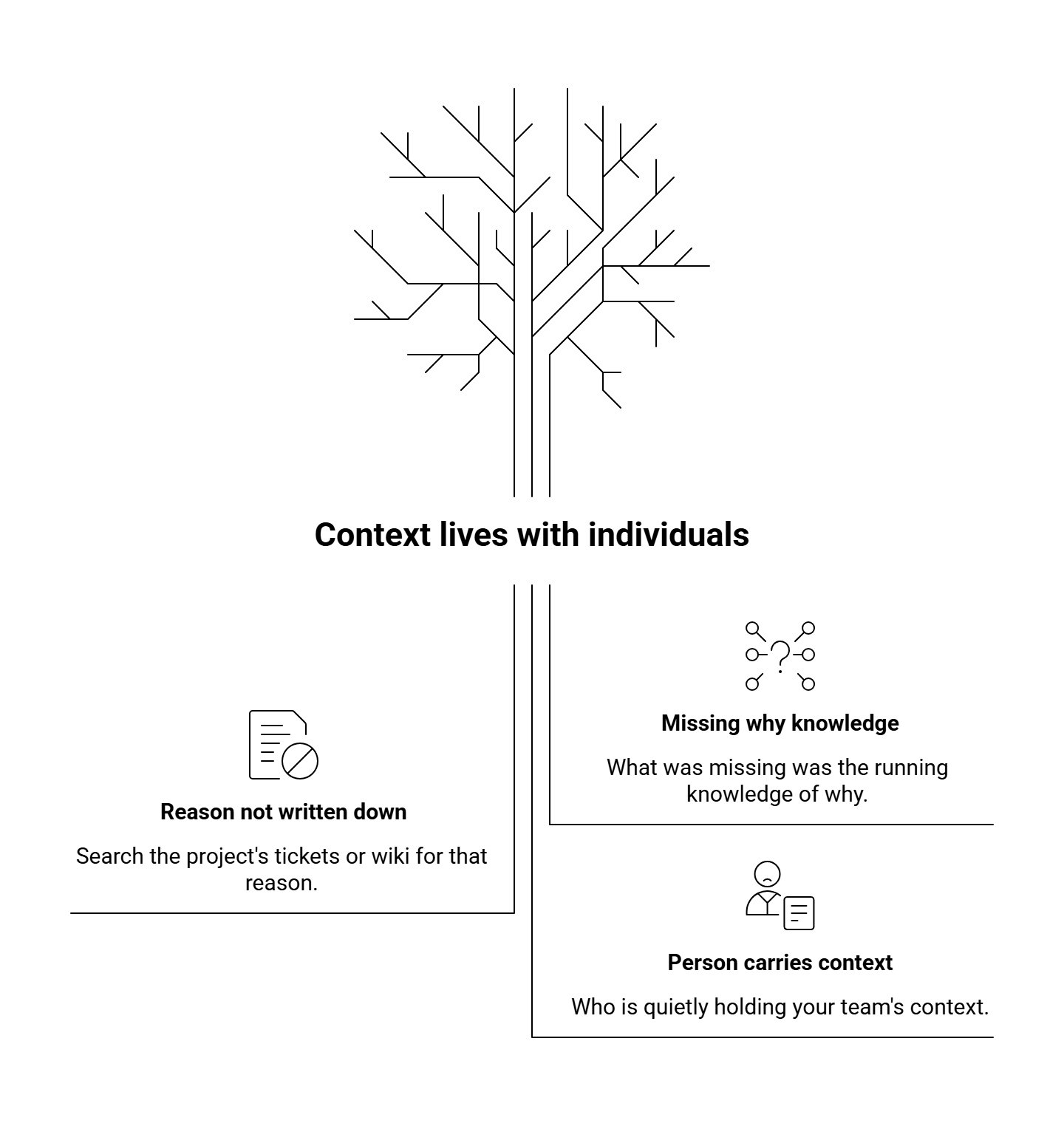
An empty search result isn't a failure. It's a map of who is quietly holding your team's context.
1 Big Idea
💡Finishing Is a Craft
There’s a quiet difference between work that passes and work that’s finished. The SWE-CoWork numbers show it plainly: a healthy share of tests satisfied, a very small share of assignments complete [1]. The most interesting detail is what didn’t help. Handing agents the full requirements at the start lifted their test pass rate by about 16 points, yet complete task success stayed where it was [1]. Finishing, it seems, isn’t only about knowing the requirements. It’s about holding them over time, noticing when two people describe them differently, and checking the result against what everyone actually meant.
Most of us have watched someone do this well without ever naming it. It’s the colleague who remembers why a decision was made two years ago, and who reads a handoff note and asks the one question that changes the answer. Nobody put them on the org chart as the keeper of context, yet work keeps finding its way to their desk. METR’s observation that agents show weaker judgment than human experts when feedback is unclear [2] points to the same place. As tools take on longer tasks, the moments that call for this kind of judgment may become more frequent, not less.
That has a gentle implication for workforce plans built around “digital labor.” If Goldman’s read is right and the transition is arriving later than many expected [3], there’s real room to plan with care, and good planning starts with a definition. When a plan counts a task as done, whose done is it? The agent’s report, the test suite, or the person who will live with the result on Monday? Plans that treat those as three separate questions tend to hold up better than plans that treat them as one.
The governors’ call for workers to have a voice in how new technology is deployed [4] fits neatly here. The people closest to the work usually know what finished looks like. Inviting them to help define “done” before a new tool arrives is considerate, and it’s also good engineering. It brings the colleague who remembers why into the design, instead of leaving them to patch the gaps afterward.
So as the week slows and the table fills, it may be worth noticing who quietly makes things finished, at home and at work. Tools will keep getting faster at starting. The people who carry work across the line deserve to be named, thanked, and asked what they’d like “done” to mean.
Hit reply and tell me who the keeper of “why” is on your team, and how they came to be that person. I read every response.
P.S. If someone you know has quietly held a project together this year, share this newsletter and help brew up stronger customer relationships.
P.P.S. If you found these AI insights valuable, a contribution to the Brew Pot helps keep the future of work brewing.
Resources
[3] Fortune: The AI layoff wave never arrived in 2026. Goldman says it's just delayed (Nov 16, 2026)
[4] National Governors Association: Governors Call for AI Action (Nov 22, 2026)
Sip smarter, every Tuesday. (Refills are always free!)
Cheers,
Nadina
Host of TechSips with Nadina | Chief Strategy Architect ☕️🍵