

“The tool can write it. Only a person can vouch for it.” — Nadina D. Lisbon
Hello Sip Savants! 👋🏾
A detection company called GPTZero spent the past year running a plain test on polished reports: do the footnotes point to anything real? Along the way it found invented citations in work from three of the big four consulting firms, and last week it added a fourth. Four PwC Middle East reports, the researchers said, leaned heavily on AI and cited sources that were thin or, in one case, described a government framework there is little public evidence ever existed [1]. PwC says it is updating a limited number of citations [2]. The useful part of this story is not the embarrassment. It is the question it hands the rest of us.
3 Tech Bites
🔍 Footnotes that led nowhere
GPTZero, with reporting verified by the Financial Times, examined four PwC Middle East “thought leadership” reports from 2024 to 2026 and found hallucinated citations and unverifiable claims [1]. One 2025 governance report, flagged as heavily AI-generated, promoted a framework called “Citizen Pulse” and said governments in several countries were already using it, though the researchers found little evidence it existed outside the report [1]. PwC said it takes the accuracy of its research seriously and is updating a limited number of supporting citations [2].
🏢 Not a one firm problem
KPMG pulled an agentic-AI report after GPTZero found only five of its 45 citations pointed to real, intact sources, and organizations named in it, including UBS and the UK’s National Health Service, said the claims about their AI use were inaccurate or misleading [3]. EY had withdrawn a report earlier in the year for similar reasons. The same tools these firms sell governance advice about were quietly writing their marketing.
🧭 The pattern reaches past consulting
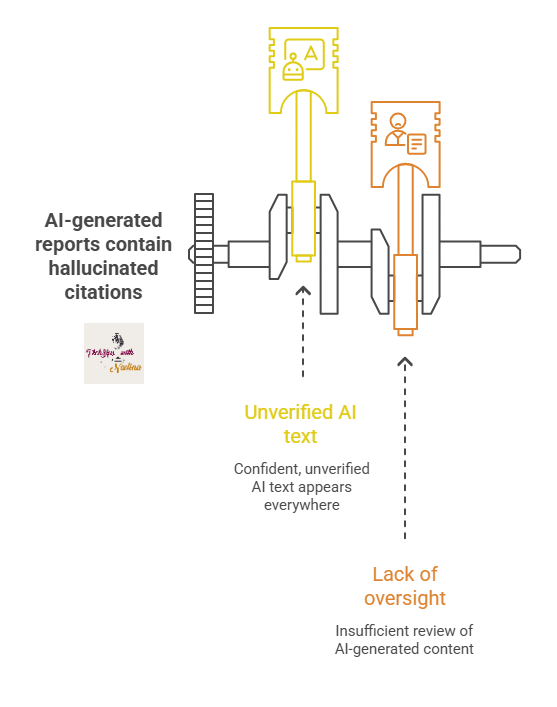
The same citation-checking work has surfaced invented references in government reports and even in academic papers submitted to major AI research conferences [1]. The lesson is not that consultants are careless. It is that confident, unverified AI text now shows up anywhere polished documents get produced, which is nearly everywhere.
5-Minute Strategy
🧠 Spot-Check Your Own Last Report
The instinct is to tell the team to be careful. A sharper move is to quietly test one thing you already shipped, yourself, right now:
Open the last external-facing document your group published with any AI help: a report, a proposal, a board deck.
Pick three specific things in it: a citation, a statistic, and a named example or case study.
Try to find each one at its original source in the next few minutes.
Mark any you cannot confirm, or that do not quite say what the document claims.
If even one does not hold, name the single person who owns the “do these sources exist and say this?” check before the next thing goes out.
This is not about catching your team. It is a lesson in diligence and trusted work. These are the moments where trust is tested, and what you do in them says a lot about the type of company you want to be, or rather portray yourself to be.
1 Big Idea
💡Whose Name Is On It
There is an easy joke in this week’s story, and it is worth setting down gently. Firms that sell advice on using AI responsibly shipped reports that a careless AI helped write. The point is not to enjoy the stumble. It is that this can happen to almost any organization moving quickly with capable tools, and it is a very human failure rather than a technical one. The model did exactly what models do. Somewhere, a review step that everyone assumed was happening simply wasn’t.
What broke was not the software. It was the chain of ownership. When a draft looks finished and reads with confidence, it is easy to assume it has been checked, and hallucinated citations are convincing precisely because they are plausible. The missing piece is a person whose job was to confirm the sources exist and say what the draft claims, and who understood that this was their job and had the time to do it.
Read the right way, that is good news about where human value now sits. As the drafting itself gets cheaper, the scarce and valuable skill becomes judgment. The willingness to put your name on something and mean it. Verification stops being clerical work and starts being the part only a person can do. The people who take it seriously become more useful in an AI-heavy workplace, not less, because they are the reason anything the organization publishes can be trusted.
The fix is small and human. Decide who takes the last look before something ships, say their name out loud, and give them enough room to actually look. Not a compliance gate, just a clear answer to a simple question. Who checked this? Most teams already have the right person for it. What tends to be missing is the explicit handoff, the moment where checking becomes someone’s owned responsibility rather than everyone’s vague assumption.
A polished document carries your organization’s name whether or not a person verified every line, and readers can no longer tell the difference from the outside. The pleasant surprise is that caring about this is a real advantage right now, at a moment when so much output looks finished but hasn’t been read closely by anyone. Slow enough to be sure, fast enough to matter. That balance is becoming its own kind of craft.
Tell me how your team decides who owns the final read, or whether that is still up for grabs. I read every response.
P.S. If a colleague is thinking through their own incident response toolkit this month, share this newsletter and help brew up stronger customer relationships.
P.P.S. If you found these AI insights valuable, a contribution to the Brew Pot helps keep the future of work brewing.
Resources
[1] Chasing the Hallucinations: PwC report hallucinates product and government customers (GPTZero)
[2] PwC thought leadership reports '100 per cent AI generated' (City A.M.)
[3] KPMG pulls report on AI usage due to apparent hallucinations (TechCrunch)
Sip smarter, every Tuesday. (Refills are always free!)
Cheers,
Nadina
Host of TechSips with Nadina | Chief Strategy Architect ☕️🍵