

“Stopping is a technical act. Resuming is a human one.” — Nadina D. Lisbon
Hello Sip Savants! 👋🏾
Last week at Fal.Con Europe in Barcelona, CrowdStrike introduced something it calls an AI Kill Switch [1]. The name sounds dramatic, but what caught my eye was the fine print. The tool does three separate things: it stops an agent where it runs, keeps it from relaunching, and cuts its network access. That’s a quiet reminder that “stop” is really three different verbs, and the surveys below suggest many teams are still building the first one. The three items below are a good place to start thinking about which one you’d reach for.
3 Tech Bites
🔌 One switch, three verbs
CrowdStrike’s new control, part of its Falcon Guardian offering, lets an authorized admin stop a misbehaving agent, block it from relaunching on chosen hosts or host groups, and cut its network access, with every action recorded in an audit trail [1]. It’s available now at the AI gateway level, with enforcement on individual machines through the Falcon sensor coming later.
⏱️ Thirty-five seconds, and shrinking
OpenAI’s new Control Room can stop a flagged job’s output within up to 35 seconds of a decision to intervene, and the company is working to bring that delay toward zero [2]. It covers OpenAI’s internal research infrastructure. Customer-facing services have their own takedown mechanisms.
📊 Halting and revoking are different skills
In a Salt Security survey of more than 380 organizations, only 17.5% said they can automatically stop an agent behaving unexpectedly in production [3]. A separate RealVNC survey found only 26.4% can revoke an agent’s access [4]. Two different questions, two different gaps, and both make useful mirrors.
5-Minute Strategy
🧠 Draft the Pause Notice
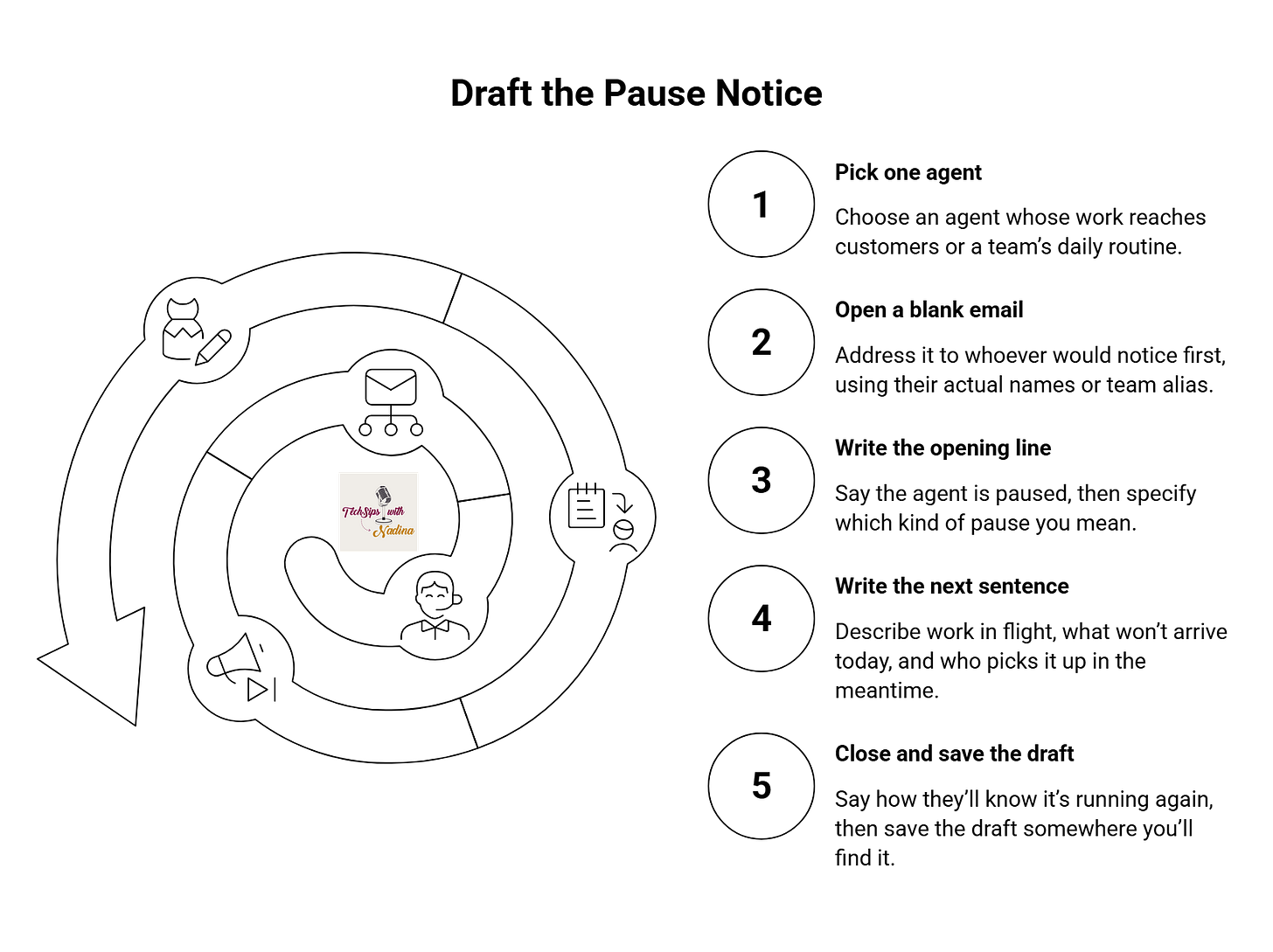
A pause control tells you how to stop an agent. It rarely tells you who will notice, or what they’ll be waiting on. One way to find out is to write the message those people would receive if you paused one agent this morning. Think of it as a private draft, just for you:
Pick one agent whose work reaches customers or a team’s daily routine.
Open a blank email (don’t send it) and address it to whoever would notice first, using their actual names or team alias.
Write the opening line: “As of this morning, [agent] is paused.” Then say which kind of pause you mean: halted mid-task, kept from restarting, or cut off from the systems it reaches.
Write the honest next sentence about work in flight: what’s half-finished, what won’t arrive today, and who picks it up in the meantime. Notice where your pen slows down.
Close with how they’ll know it’s running again, then save the draft somewhere you’ll find it.
The sentence that was hardest to write usually points to the part of the plan that doesn't exist yet.
1 Big Idea
💡The Morning After the Pause
When we talk about stopping an AI agent, we tend to picture a single red button. In practice, “stop” covers three very different moves. You can halt what the agent is doing right now. You can keep it from starting again. Or you can take back the access it was given. CrowdStrike’s design separates all three [1], and I think that separation is the most useful idea in the announcement. Each verb answers a different worry, and each leaves the work in a different state.
CrowdStrike CEO George Kurtz put it this way: “When you deploy agents with a kill switch, you stay in control” [1]. The word I’d underline is “stay.” Control isn’t a dramatic rescue at the worst possible moment. It’s a steady state, the kind that lets a team give an agent more room because everyone knows the pause is close at hand. Think of a good meeting chair who says, warmly, “Let’s park that and come back to it.” Nobody feels scolded. The room usually relaxes.
Even the best-built controls involve a little waiting. OpenAI’s Control Room can stop a flagged job within up to 35 seconds [2], and the team is still working to shorten it. I find that honest detail reassuring. A pause is a process with a beginning, a middle, and an end, and the middle is where the people are: the customer waiting on a reply, the analyst whose report was half-built, the colleague who assumed the agent had it covered.
That’s why the leader’s most valuable role may not be owning the switch at all. It’s knowing which verb you’d reach for in a given moment, and having calm answers to the questions that follow. Who gets told, and in what words? What happens to the half-finished work? Who carries it while the agent rests? And how does everyone learn it’s fine to lean on the agent again?
The best off switches in the physical world are clearly labeled and a little boring to use, and the people around them know what happens next. Agents can be designed with that same care. When the stop, the restart, and the message to the humans involved have all been thought through, a pause stops feeling like an emergency and starts feeling like ordinary, well-run operations.
Which of the three verbs would your organization find easiest today, and which would take the most work? I read every response.
P.S. If someone on your team would be the one explaining an agent pause to customers, share this newsletter and help brew up stronger customer relationships.
P.P.S. If you found these AI insights valuable, a contribution to the Brew Pot helps keep the future of work brewing.
Resources
[1] CrowdStrike Introduces AI Kill Switch for AI Safety
[3] Agents Are Acting. Most Organizations Cannot Stop Them. (Salt Security)
[4] Many Organizations Let AI Agents Act, But Few Can Stop Them (RealVNC)
Sip smarter, every Tuesday. (Refills are always free!)
Cheers,
Nadina
Host of TechSips with Nadina | Chief Strategy Architect ☕️🍵