

“The tools got faster. The people who point them got more valuable.” — Nadina D. Lisbon
Hello Sip Savants! 👋🏾
Upwork released its Future Workforce Index on July 14, and it rewards a second read [1]. Skilled freelancing jumped from 28% to 38% of the US knowledge workforce in a single year, and 58% of full-time employees say they’re now considering it themselves. What caught my attention was the split hiding inside the AI numbers. Freelancers doing genuinely complex work with AI saw earnings rise 45%, while simpler generative work grew fast in volume but paid less per contract. It’s a tidy snapshot of a larger shift, one where routine execution gets cheaper and judgment gets a raise. Here are three items that trace where the value is actually landing.
3 Tech Bites
🧭 A new role gets a name
Upwork’s index describes an emerging kind of professional, the AI Orchestrator: someone who connects AI tools to real domain expertise, applies judgment, and owns the business outcome rather than the output. Freelancers doing more complex work with AI saw earnings climb 45% year over year [1].
💸 Busier and cheaper, at the same time
The sharpest number in the report is a divergence. Generative AI and creative production work saw contract starts grow 90% year over year while earnings per contract fell 13%. Meanwhile AI-augmented professional services, where domain experts fold AI into established fields, grew 72% in volume with earnings up 22% [1]. More demand doesn’t automatically mean more money.
📊 Two tracks, not one
PwC’s 2026 Global AI Jobs Barometer, drawn from more than a billion job ads across 27 countries, finds that roles where AI absorbs the routine and leaves room for human judgment (radiologists, recruiters) are seeing twice the job growth and 42% faster salary growth than roles AI simply makes easier for non-experts. The wage premium for AI skills reached 62%, up from 57% last year [2].
5-Minute Strategy
🧠 What the Invoices Already Know
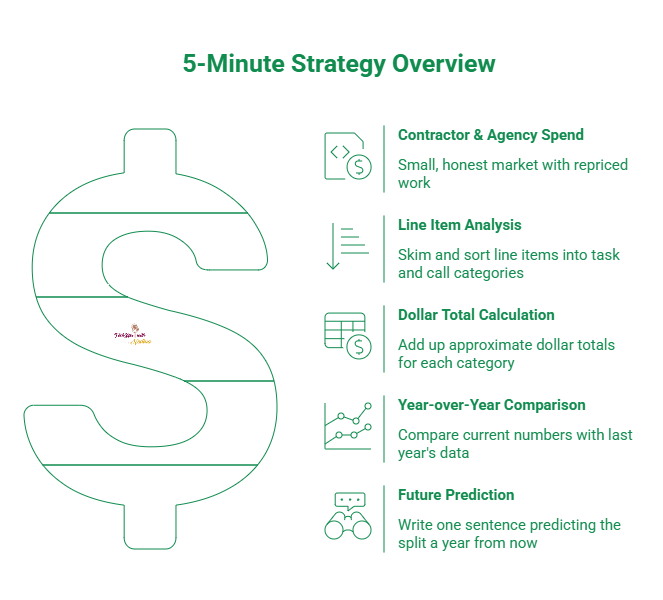
Your contractor and agency spend is a small, honest market that has already repriced this work. It’s a quick read, and it’s worth doing yourself rather than routing to finance:
Pull up last quarter’s contractor or agency spend for your own area.
Skim the line items and sort them into two rough piles: work where someone executed a task, and work where someone made a call.
Add up the approximate dollar total in each pile.
If last year’s numbers are handy, compare, and note which pile grew.
Write yourself one sentence predicting what that split looks like a year from now.
Your own spend tends to run a few quarters ahead of your org chart. It’s usually telling you something.
1 Big Idea
💡 The First Rung, Rebuilt
For a long time, junior roles were where people learned a craft by doing its most repetitive parts. That repetition was the point. It was how pattern recognition got built, how someone came to know at a glance that a number looked wrong. Now that AI increasingly handles that repetitive layer, the interesting question isn’t whether entry-level work survives. It’s where the learning goes.
PwC’s research offers a detail I keep turning over. In the US, entry-level roles most exposed to AI are seven times more likely to ask for skills once considered senior, things like leadership, creativity, and comfort sitting across from a client. Openings for those roles have grown 35% since 2019, while other entry-level jobs shrank 10% over the same stretch [2]. Read that slowly. The junior jobs that are growing are the ones asking new people to bring more of themselves, sooner.
That’s a real change in what “junior” means. The old apprenticeship went roughly like this: handle the routine work until you’ve earned the judgment calls. The version taking shape looks more like pairing with AI on the routine from day one, and being asked for taste and judgment years earlier than most of us had to offer it. It’s a heavier lift for someone three years into a career. Handled with some care, it’s also a faster and far more interesting way to grow into one.
The freelance numbers describe the same shift from a different angle. The work that’s gaining value is the complex kind, where someone layers expertise and business context on top of what the model produces, while the more commodity work grows busier without growing more valuable [1]. That’s essentially a job description for judgment. And judgment is the one thing we’ve historically asked people to earn slowly, in exactly the routine work that’s now being handled for them.
So the puzzle worth sitting with is a design puzzle, not a forecast. Someone has to decide which tasks a first-year person keeps because the learning lives there, even when a model could do them quicker. That decision doesn’t make itself, and it rarely shows up on a roadmap. The question in front of us isn’t whether there’s room for new people. It’s how thoughtfully we build that room.
I’d be curious which tasks you’d protect for a first-year hire, even knowing a model could do them faster. I read every response.
P.S. If someone on your team is rethinking what a first-year role should look like, share this newsletter and help brew up stronger customer relationships.
P.P.S. If you found these AI insights valuable, a contribution to the Brew Pot helps keep the future of work brewing.
Resources
Sip smarter, every Tuesday. (Refills are always free!)
Cheers,
Nadina
Host of TechSips with Nadina | Chief Strategy Architect ☕️🍵