

“We are trading physical carbon for digital convenience at a rate the earth's grids can't sustain, forgetting that the most efficient neural network still sits right between our ears.” — Nadina D. Lisbon
Hello Sip Savants! 👋🏾
This week kicked off with major announcements from Computex 2026, showcasing incredibly powerful new AI hardware [1]. Yet beneath the glossy product keynotes lies an escalating friction. Silicon Valley is hitting a hard physical ceiling of energy consumption [2], while simultaneously shifting its human balance sheet through structural layoffs [3]. We need to look past the interface and talk about the infrastructure.
3 Tech Bites
💻 The Edge Acceleration Race
Computex 2026 proved that the next battlefield is local silicon [1]. Tech giants are rushing to embed dedicated AI processing units directly onto consumer devices to bypass cloud latency.
🔋 Gridlock at the Data Center
Wall Street is pouring capital into specialized infrastructure stocks as data centers face severe power and cooling shortages [2]. The physical weight of the cloud is officially bottlenecking software deployment.
✂️ The Silicon Restructure
The New York Times confirmed a sharp escalation in tech layoffs specifically driven by automated restructuring [3]. Companies are aggressively shifting budget allocations from engineering headcount to raw compute power.
5-Minute Strategy
🧠 The AI Technical Debt Audit Do not wait for a corporate restructuring to evaluate how algorithmic dependencies impact your work. Spend 5 minutes diagnosing your operational pipeline to ensure you are building structural, irreplaceable value.
Map Your System Dependencies: Identify where your workflows rely on external LLM calls or automated code generation. Are you using a 70-billion-parameter model to perform basic regex or data parsing that local, deterministic code could execute?
Isolate the Strategic Core: Pinpoint the exact architectural inflection points in your current projects where standard patterns fail. This is your baseline. These are the highly contextual, ambiguous edge cases that require historical system knowledge and human negotiation.
Optimize the Local Stack: Move your iterative prototyping, draft refinement, and small-scale testing to local language models running fully on your own machine’s hardware.
By shifting your standard processes to local environments and reserving heavy cloud models exclusively for high-leverage problems, you minimize external data liabilities while sharpening the precise architectural skills that automated systems cannot replicate.
1 Big Idea
💡 The Irony of the Automated Balance Sheet
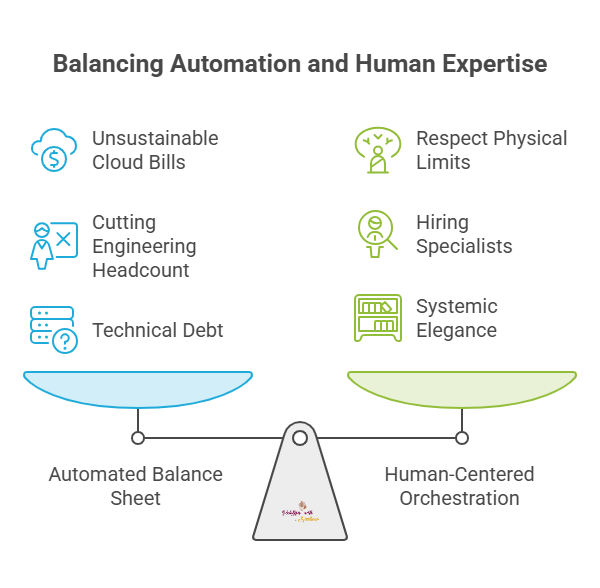
When we talk about the cloud, the vocabulary we use is intentionally deceptive. We use terms like “serverless” and “virtualization” to make our digital infrastructure feel as light as mist. The physical reality of the AI boom is entirely different. It is heavy metal, copper wiring, massive diesel backup generators, and millions of gallons of water cycled away to keep silicon plates from melting under the load of our inference prompts [2]. Recent analysis indicates that global data center energy consumption is rapidly accelerating to unprecedented and unsustainable levels [5].
To fund these massive infrastructure bills, corporate boards are making a short sighted trade. They are cutting traditional engineering headcount and entry level roles to reallocate capital directly into raw compute power [3]. They are essentially betting that software capacity can be bought wholesale via a cloud subscription rather than nurtured through human talent.
But this is where the corporate logic completely fractures. Massive language models are incredibly inefficient and financially draining to run at scale. Companies that tried to blindly replace human workflows with automated API calls are suddenly staring at unsustainable cloud bills and broken edge cases. They are discovering that you cannot automate a complex system without creating a massive wave of technical debt.
This has triggered a fascinating and ironic reversal. Organizations are now scrambling to hire and retain specialized engineers to fix the efficiency crisis. They do not need generalists anymore. They need architects who can move models to the local stack [1], design deterministic fallback systems, and optimize the heavy code patterns that are currently draining the corporate budget. The very models designed to reduce headcount now require a new army of infrastructure specialists just to keep them running sustainably.
We must change the narrative from total automation to human centered orchestration. True systemic elegance means building architectures that respect physical and financial limits rather than ignoring them. If we destroy our engineering pipeline today to pay for a temporary compute spike, we will be left with complex, brittle systems that nobody understands how to maintain from scratch.
If this edition resonated with you, hit reply or leave a comment and let me know. I read every response.
P.S. If you are tired of pretending the cloud is weightless, share this newsletter and help brew up stronger customer relationships!
P.P.S. If you found these AI insights valuable, a contribution to the Brew Pot helps keep the future of work brewing.
Resources:
[1] Computex 2026: All the news and announcements
[2] 7 Best Data Center Stocks, ETFs and REITs to Buy
[3] Is A.I. Replacing Tech Workers or Providing an Excuse for Job Cuts?
[4] International Energy Agency. Data Centres and Data Transmission Networks
[5] Global energy demands within the AI regulatory landscape
Sip smarter, every Tuesday. (Refills are always free!)
Cheers,
Nadina
Host of TechSips with Nadina | Chief Strategy Architect ☕️🍵