
The Hangover After the Hype
Why the "AI Bubble" fears might actually be the sobriety check we need.

“We build the future not just with code, but with the questions we ask of it.” — Nadina D. Lisbon
Hello Sip Savants! 👋🏾
Doing some last-minute shopping? Enjoy 45% OFF the entire TechSips shop all the way through Jan 5th. No deadlines, just joy.
✨ Use Code: SIPJOY45 ✨
You can feel the vibe shifting. The ‘AI can do anything’ euphoria is finally colliding with a wall of economic reality. While the headlines are busy predicting a bubble burst and scrutinizing debt [1], I see this as a necessary grounding. We are trading the dizziness of hype for the stability of proof. It’s no longer about how much we spend on AI, but how we connect it to actual human needs. The party might be quieting down, but the real work is just getting started.
3 Tech Bites
🔮 2026: The Year of the “Receipt”
Stanford experts predict the “era of AI evangelism” is officially ending. By 2026, expect it to be replaced by the “era of evaluation.” The focus will shift from asking “Can AI do this?” to “Is this actually profitable?” Watch out for new “AI economic dashboards” that finally track real productivity versus the hype [2].
🚗 The “Boring” Wins
While flashy chatbots grab the headlines, the real revolution is happening quietly in factories. Automakers like BMW are using predictive AI to cut downtime by nearly 50%. It’s unglamorous, highly specific, and incredibly valuable. This is exactly the kind of AI that survives a bubble burst [3].
🤝 The Privacy Pivot
As the market tightens, the “Wild West” of public data is closing. Partners like MAXXYS and Pellera are seeing a massive shift toward “Private AI.” These are secure, internal clouds where companies control their own destiny rather than renting intelligence from tech giants [4].
5-Minute Strategy
🧠 The “Human Premium” Calculation
If the bubble bursts, tools that automate routine work will get cheaper, but the human element will get more expensive. Spend 5 minutes mapping your “Human Premium” to see where you are most valuable.
List your top 3 outputs (e.g., Reports, Code, Client Strategy).
Ask yourself: “If I used AI to do 80% of this task, does the value go up or down?”
Does the value drop? (e.g., Personal mentoring). This is your Human Premium. Protect and highlight it.
Does the value rise? (e.g., Data entry). This is a Commodity. Automate it aggressively before budgets tighten.
The Pivot: Shift one hour this week from a “Commodity” task to a “Human Premium” task.
1 Big Idea
💡 The Debt of Innovation
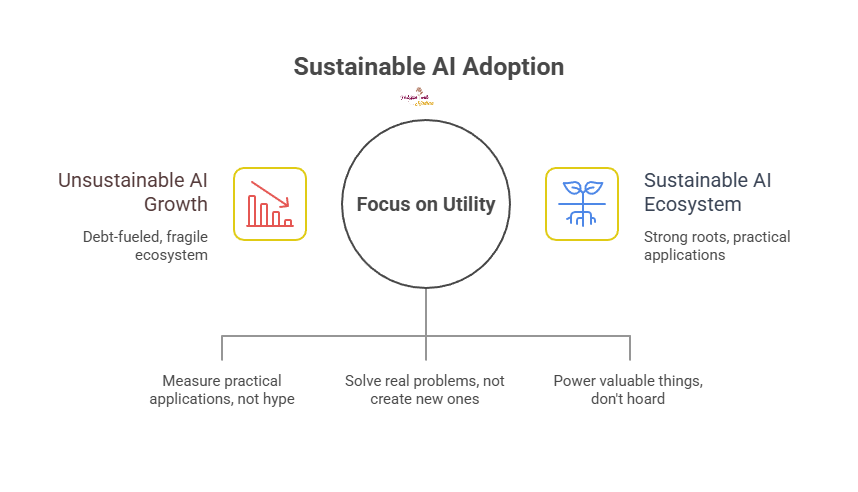
The anxiety on Wall Street isn’t just about stock prices; it’s about sustainability. Reports are surfacing about the “mountains of debt” fueling the current data center rush, raising fears of a crash if growth doesn’t accelerate indefinitely [1]. This is what I call the “Debt of Innovation.”
When we hyper-scale technology using debt and circular financing (where companies invest in their own customers to boost revenue), we create a fragile ecosystem. If the bubble pops, investors won’t be the only ones hurting. The real victims will be the small businesses and employees who pivoted their workflows around tools that might suddenly disappear.
The Stanford prediction for 2026 hits the nail on the head: we are moving into an era of evaluation [2]. This is good news. It means we stop celebrating the existence of AI and start measuring its utility. The companies that survive won’t be the ones with the flashiest demos, but the ones with the strongest roots. These are the companies building practical applications that solve real problems (like automotive predictive maintenance) rather than creating new ones.
We need to treat AI not as a magic money printer, but as a utility, just like electricity. You don’t hoard electricity; you use it to power something valuable. As we head into 2026, let’s focus less on speculation and more on application. Are we building tools that support our workforce, or just inflating a balloon that leaves us empty-handed when it bursts?
If your favorite AI tool doubled in price next month (a real possibility if VC subsidies dry up), would you keep it?
P.S. Know someone else who could benefit from a sip of AI wisdom? Share this newsletter and help them brew up stronger customer relationships!
P.P.S. If you found these AI insights valuable, a contribution to the Brew Pot helps keep the future of work brewing.
Resources
“Wall Street Sees an AI Bubble Forming and Is Gaming What Pops It,” Bloomberg
“Stanford AI Experts Predict What Will Happen in 2026, Stanford HAI
“AI Transforms Automotive Manufacturing from Reactive Fixes to Predictive Intelligence,” Design News
“The Broadcom Partner Difference: Navigating AI Adoption,” Broadcom
Sip smarter, every Tuesday. (Refills are always free!)
Cheers,
Nadina
Host of TechSips with Nadina | Chief Strategy Architect ☕️🍵