
The $2.5 Trillion Question
Moving past the hype to find the human heartbeat in the machine.

“We’re building a faster brain for the world. But are we remembering to check its pulse?” — Nadina D. Lisbon
Hello Sip Savants! 👋🏾
We’ve officially hit the “put your money where your mouth is” phase of the AI revolution. The forecasts are in, the budgets are set, and the numbers are staggering. With Gartner projecting $2.5 trillion in AI spending this year [1], we aren’t just dipping our toes in anymore; we are swimming in the deep end. But as the IMF confirms that this tech boom is the main engine keeping the global economy afloat [2], a critical tension is emerging between the massive spend and the actual, tangible human value we’re getting in return.
3 Tech Bites
💸 The “Trough” is Real
We are firmly in what Gartner calls the “Trough of Disillusionment.” The excitement of the pilot phase is over. Now comes the hard, unglamorous work of making that $2.5 trillion actually pay off. Companies are realizing that writing a check for GPU power doesn’t fix a broken culture [1].
🌐 The Economic Life-Raft
It’s a strange time when server farms are the hero of the global economy. The IMF reported yesterday that despite trade wars and tariff headaches, AI investment is the primary force pinning global growth at a steady 3.3%. We are effectively engineering our way through economic headwinds [2].
✨ The Innovation Pivot
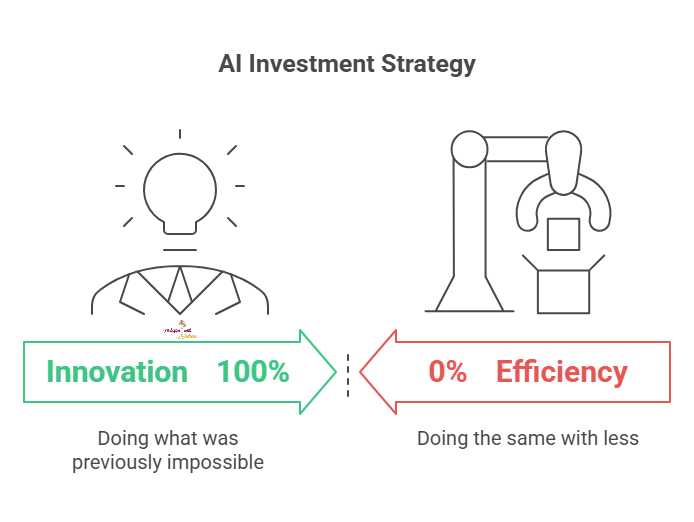
If your Q1 strategy is just “cutting costs,” you’re fighting the last war. A new IBM study reveals that by 2030, the winners will be those who shifted spend from efficiency to innovation [3]. The goal isn’t just to do the same work faster; it’s to use AI to do work we couldn’t dream of before.
5-Minute Strategy
🧠 The “Analog Anchor” Technique
Stop letting the algorithm dictate the conversation. Use this quick prep before your next presentation or meeting.
Identify the “Black Box” Output
Take one AI-generated insight, chart, or summary you plan to present.
Find the Human Story
Ask yourself, “Who is the specific person impacted by this data point?”
The customer who waits 2 minutes less.
The employee who no longer does data entry.
The Anchor
Open your update with that human story first, then support it with the AI data.
Bad: “Our AI improved efficiency by 12%.”
Good: “Sarah in CS can now spend 5 extra minutes with escalated clients because our new tool handled the routine queries. This drove a 12% efficiency gain.”
1 Big Idea
💡The Efficiency Trap in a Trillion-Dollar World
We are standing at a precarious intersection. On one side, the IMF tells us AI is the only thing saving the global economy from stagnation. On the other, Gartner warns that disillusionment is setting in because the “magic” isn’t instant. The disconnect comes from a fundamental misunderstanding of what we are buying with that $2.5 trillion. Currently, many organizations are caught in the "Efficiency Trap," investing heavily to speed up slightly flawed processes.
The IBM study released this week highlights the necessary exit strategy. We are seeing a massive shift where the primary value of AI moves from efficiency (doing the same with less) to innovation (doing what was previously impossible). This is where the human element becomes non-negotiable. Efficiency is a machine’s game; innovation is a human one. If we use this year’s massive spend solely to flatten org charts, we risk hollowing out the very layer of human creativity needed to drive the next phase of growth.
The danger is prioritizing metrics that are easy to measure (speed, headcount) over metrics that sustain us (adaptability, trust). We are building an infrastructure powerful enough to run the world, but we need to ensure we aren’t designing it to exclude the people living in it. The “Smart Business” of the future won’t be the one with the most compute; it will be the one that used AI to liberate its workforce from drudgery so they could invent what comes next.
Are you feeling the pressure to "innovate" or just "automate" right now? I'd love to hear how your organization is handling this shift.
P.S. Share this newsletter and help brew up stronger customer relationships!
P.P.S. If you found these AI insights valuable, a contribution to the Brew Pot helps keep the future of work brewing.
Resources
Sip smarter, every Tuesday. (Refills are always free!)
Cheers,
Nadina
Host of TechSips with Nadina | Chief Strategy Architect ☕️🍵