

“The chat window feels like a notepad. It keeps notes like a filing cabinet.” — Nadina D. Lisbon
Hello Sip Savants! 👋🏾
Few of us ever go back and reread what we’ve typed into an AI tool. This month, an access key that Cursor had issued to its AI inference provider, Fireworks AI (the company running models behind the scenes), was exposed at Fireworks [1][2]. Within days of each other, Cursor [1], Notion [3] and Uber [4] each described incidents tied to that same provider. What surfaced was mostly the everyday trail of people working with AI: coding-agent traces and chat transcripts. The three items below are worth a few minutes this week.
3 Tech Bites
🔑 One key, a long reach
Cursor says the key was used to copy data from a storage bucket it shared with Fireworks. The bucket held limited coding-agent traces (mostly from 2025) from sessions not in Privacy Mode, and a small number of those traces contained credentials that had not been redacted [1]. Cursor puts the exposure at “fewer than 0.05%” of users not in Privacy Mode, and says Privacy Mode prompts and code were not affected [1].
💬 Chat transcripts, now part of the record
Notion says “fewer than 1%” of workspaces were affected, and the exposed data was Notion AI chat transcripts used for its Insights feature [3]. Its advice was refreshingly plain: if you pasted passwords, API keys or other credentials into Notion AI during the incident, rotate them [3].
🚗 The vendor behind your vendor
Uber confirmed an incident at Fireworks.ai, a third-party vendor “which had access to some Uber data” [4]. State notices so far list 2,567 people in Massachusetts, 3,430 in South Carolina and 1,873 in Rhode Island, involving personal and driver’s license information. Uber hasn’t shared a total [4].
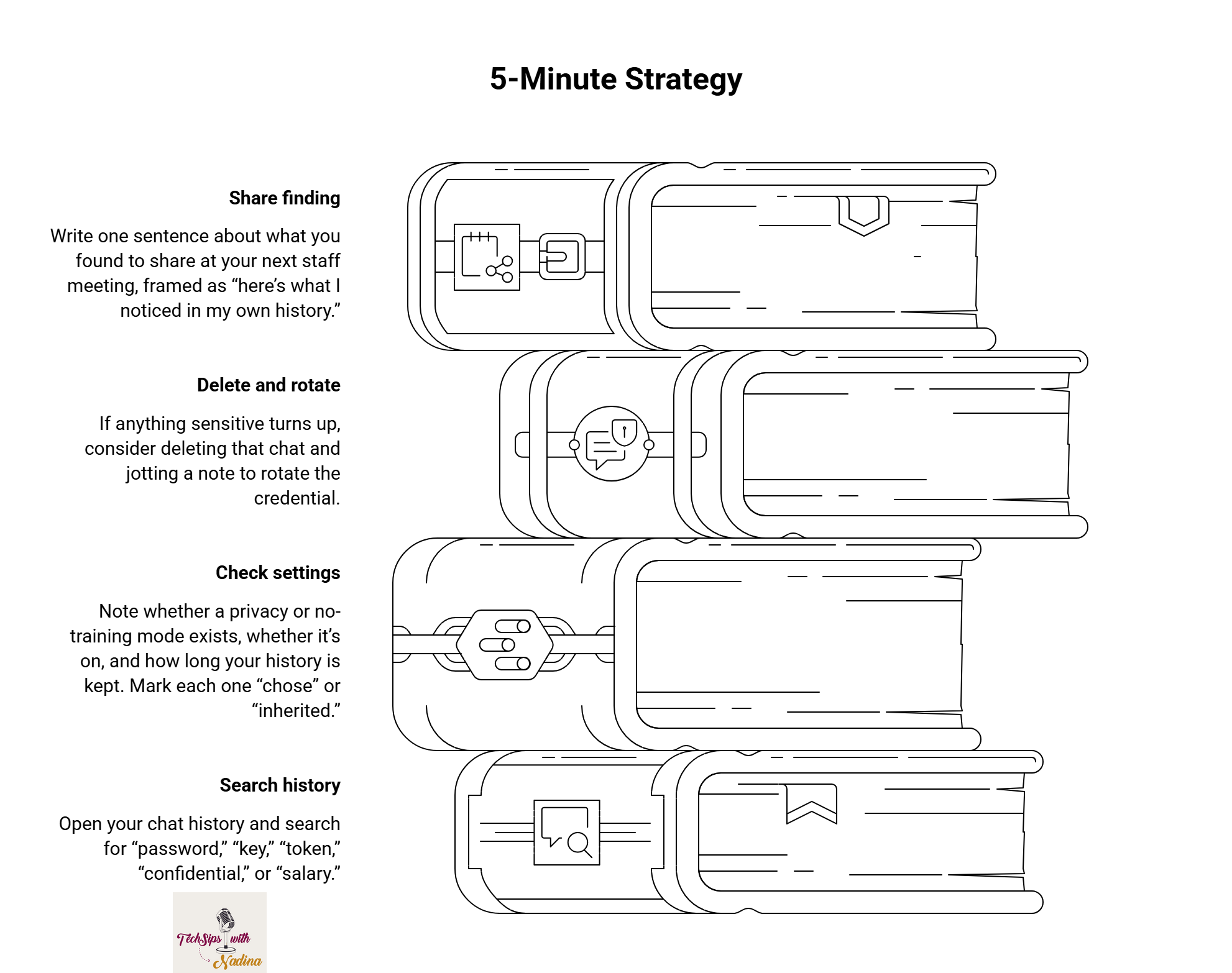
5-Minute Strategy
🧠 Read Your Own AI Diary
Most leaders have reviewed a vendor contract. Far fewer have looked back through their own AI history. One option is to spend five quiet minutes doing exactly that, in the AI assistant you use most for work. Think of it as a personal check-in, not an audit:
Open your chat history in that tool and use its search box.
Try a few words: “password,” “key,” “token,” “confidential,” “salary.” Notice what comes back.
Open the tool’s settings and note whether a privacy or no-training mode exists, whether it’s on, and how long your history is kept. Mark each one “chose” or “inherited.” Cursor’s Privacy Mode is a good reminder that these toggles can matter [1].
If anything sensitive turns up, consider deleting that chat and jotting a note to rotate the credential, the same step Notion suggested to its customers [3].
Write one sentence about what you found to share at your next staff meeting, framed as “here’s what I noticed in my own history.”
When a leader goes first, everyone else gets permission to look.
1 Big Idea
💡The Notebook We Forgot We Were Keeping
Most of us treat AI tools the way we used to treat sticky notes. We paste in a half-finished email, a snippet of config, a customer complaint, maybe a password we were too tired to mask. It feels like thinking out loud. That’s the whole charm of a conversation: it doesn’t feel like a document.
But it is one now. The stories this month show those exchanges being stored, shared with the providers that power our tools, and sometimes exposed. Cursor’s traces sat in a bucket it used to share data with Fireworks [1]. Notion’s exposed data was AI chat transcripts [3]. Uber described an incident at a third-party vendor “which had access to some Uber data” [4]. Nobody had to be reckless for any of this to happen. It only took people working the way people naturally work.
So I’d gently resist the urge to find someone to blame. The engineer who pasted a key into a coding assistant was trying to fix something quickly. The manager who asked an AI to summarize a tense thread was trying to be thoughtful. These are good instincts. The interesting question is how we help those instincts travel with a little more care.
Part of the answer is design, and some of it already exists. Cursor says sessions in Privacy Mode were not affected [1]. That one setting changed what was in the bucket. Small defaults like that may be worth knowing by name, the way we once learned which folders were backed up and which weren’t.
The bigger part is culture. If someone on your team realizes they pasted a credential into a chat, it helps when they feel free to say so out loud, quickly, and without embarrassment, so it can be rotated and forgotten. A conversation with an AI is a work record now. Treating it with the same easy respect we give any other record is a kindness to our future selves.
What did you find when you looked back at your own AI chats? I read every response.
P.S. If someone you work with types into an AI tool more often than they type into email, share this newsletter and help brew up stronger customer relationships.
P.P.S. If you found these AI insights valuable, a contribution to the Brew Pot helps keep the future of work brewing.
Resources
[1] Cursor: Security incident update (Nov 13, 2026)
[2] Fireworks AI: Security Bulletins, October 2026 security incident
[3] SecurityWeek: Notion customer data compromised in Fireworks AI hack (Nov 12, 2026)
Sip smarter, every Tuesday. (Refills are always free!)
Cheers,
Nadina
Host of TechSips with Nadina | Chief Strategy Architect ☕️🍵