

“Finding a flaw is the easy half. Fixing it is the half that counts.” — Nadina D. Lisbon
Hello Sip Savants! 👋🏾
Much of the conversation about AI and security has focused on what attackers might do with it. Last week offered a more encouraging chapter. On June 22, OpenAI expanded its Daybreak security effort with a model and a program built squarely for defenders, including one aimed at the open-source software almost every company quietly runs on [1]. It is a good moment to think about AI as something that helps us repair, not only something to guard against. Three items worth a few minutes.
3 Tech Bites
🛡️ A model tuned to fix, not just find
OpenAI released GPT-5.5-Cyber, built to help defenders locate and patch software flaws [1]. It scored 85.6% on the company’s CyberGym test for reproducing known vulnerabilities, up from 81.8% for the standard model, and access runs through a vetted partner program rather than open release [3].
🔧 Tending the open-source commons
A new initiative called Patch the Planet, founded with Trail of Bits, helps maintainers move from spotting bugs to actually fixing them [2]. More than 30 widely used projects have signed on, including cURL, Go, Python, and Sigstore.
🧰 Scanning where the work already happens
A new Codex Security plugin brings vulnerability checks into the developer’s normal workflow [3]. The pattern worth noting is the direction: putting the strongest tools in the hands of the people doing the defending.
5-Minute Strategy
🧠 Thank (or Sponsor) One Maintainer
A surprising amount of enterprise software rests on open-source projects kept alive by a handful of volunteers. With maintainers in the spotlight lately, here is a small, uncommon move that carries real goodwill and resilience:
Ask your engineering lead which single open-source project your stack leans on most.
Look up who maintains it and how it is funded, which is often a very small team.
Pick one supportive step: a modest recurring sponsorship, or a short note offering help.
While you are there, note whether the project has a security disclosure process you could plug into.
Send the message, or start the sponsorship.
The software you depend on is maintained by people, and a little support tends to go a long way.
1 Big Idea
💡 Tools That Point Toward Repair
For a couple of years, the security story around AI has leaned toward worry. If a model can find a weakness, the thinking goes, then someone will misuse it. That concern is fair and worth taking seriously. What is easy to miss is that the same capability, pointed the other way, is unusually good news. A tool that can find a flaw can also help close it, and the latest news put that second use front and center [1].
The piece I keep coming back to is the focus on open-source maintainers [2]. So much of the modern world runs on libraries written and looked after by small groups of people, often unpaid, often stretched thin. They carry a remarkable load on behalf of everyone else. Aiming capable tools at helping them move from a long list of findings to a manageable set of fixes is a quietly humane idea, and it strengthens the foundations the rest of us build on.
There is also something worth noticing in how it was released. Rather than handing the strongest version to anyone who asked, the defensive model is reaching people through a vetted program [3]. You can debate the details, but the instinct behind it, matching access to responsibility, is a thoughtful one. It treats capability as something to steward rather than simply to ship.
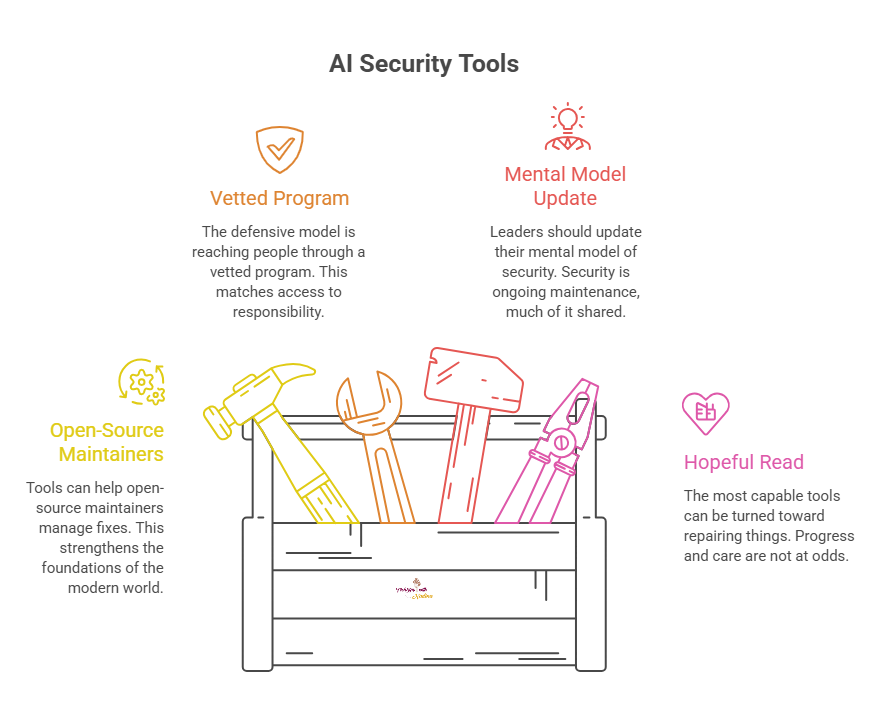
For leaders, none of this calls for a dramatic response. It is more of an invitation to update a mental model. Security is not only a wall you stand behind. It is also ongoing maintenance, much of it shared, much of it done by people you will never meet. Tools that help that work get done are worth welcoming, and worth supporting where you can.
The hopeful read here is simple. The most capable tools we are building can be turned toward tending and repairing the things we all rely on. That is a future worth leaning into, and a reminder that progress and care are not at odds.
I would love to hear how your teams are thinking about AI on the defensive side of the ledger. I read every response.
P.S. If a colleague spends their days keeping systems safe, share this newsletter and help brew up stronger customer relationships.
P.P.S. If you found these AI insights valuable, a contribution to the Brew Pot helps keep the future of work brewing.
Resources
[1] Daybreak: Tools for securing every organization in the world (OpenAI)
[2] Patch the Planet: a Daybreak initiative to support open source maintainers (OpenAI)
[3] OpenAI Expands Daybreak With GPT-5.5-Cyber to Help Defenders Patch Security Flaws (The Hacker News)
Sip smarter, every Tuesday. (Refills are always free!)
Cheers,
Nadina
Host of TechSips with Nadina | Chief Strategy Architect ☕️🍵