

“The absence of a mark is not the presence of a person.” — Nadina D. Lisbon
Hello Sip Savants! 👋🏾
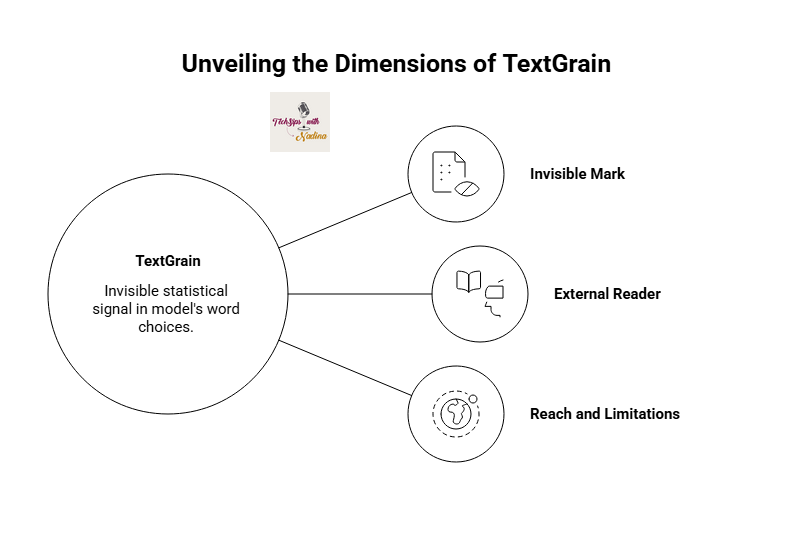
Provenance used to live in a file. As of October 5, a slice of it lives in the writing itself. OpenAI described a method it calls textGrain, which adds “an invisible statistical signal to the model’s word choices” [1]. So the mark isn’t sitting in a header or a line of metadata. It’s in which word showed up where. What makes that worth a few minutes isn’t the mark, it’s that the tool which reads it sits somewhere else. Three items below on where the new layer reaches, and where it doesn’t.
3 Tech Bites
✍️ The signal moved into the sentence
OpenAI will add an invisible watermark to eligible ChatGPT and Codex text output in the European Union over the coming weeks, across all plans, EU only at launch [1]. In the API it stays off by default, with worldwide opt-in from October 5 for select models. Detector access is open by application to approved researchers and expert organizations, case by case for now [1].
🔗 Anthropic got there in August
Anthropic said all models released after August 2 will automatically have tech to watermark both generated text and files, with older models to follow [2]. It’s applied at the model level, so it should show up regardless of product, across the Claude platform API, Claude, Claude Code, Claude Cowork and Claude Tag. Files use the C2PA open standard, and the text mark travels with the text when it’s copied and pasted [2].
📏 The 200-token floor
The European Commission published its Code of Practice on marking and labelling AI-generated content on June 10, 2026, voluntary steps toward the transparency obligations that apply from August 2 [3]. In one legal reading, watermarking is exempt for very short free-form text, under 200 tokens, and metadata marking doesn’t apply to free-form text at all, since text can’t carry it [4].
5-Minute Strategy
🧠 Measure Your Own Edit Pass
OpenAI’s own reported evaluations show that on 400-token passages, replacing 10% of words with synonyms took detection from about 92% to 66%, and replacing 25% took it to 17% [1]. If you’re curious how that compares with an ordinary editing pass, you can find out on a document you already finished.
Open something you personally edited from an AI-assisted first draft, with version history or tracked changes turned on.
Pick one substantial paragraph and count the words you changed, replaced or cut.
Divide that by the paragraph’s word count, so you have your own percentage.
Set it next to OpenAI’s two figures: 10% of words swapped took detection to about 66%, and 25% took it to 17% [1].
Write yourself one line about what your percentage means for the text your team sends out as finished work.
Most ordinary editing already lands in the range where the signal fades, which tells you a good deal about what the mark measures and what it doesn’t.
1 Big Idea
💡The Part That Stays Yours
There’s a quiet detail in OpenAI’s October 5 write-up that I keep turning over. The watermark gets weaker the more the text is edited, and the company says so directly, noting that editing can weaken the watermark and that provenance for text has to account for how easily writing can be rewritten, translated, or edited [1]. Read one way, that’s a limitation. Read another way, it’s a measurement of something we’ve never had a number for, which is how much of a finished piece is still the machine’s first draft. I find the second reading more useful.
The figures are OpenAI’s own reported evaluations, and they’re worth reading slowly. At a target false positive rate of 1%, its detector identified watermarks in about 80% of 200-token passages and about 95% of 400-token passages of psychology content, with results substantially lower for mathematics [1]. On 400-token passages, replacing 10% of words with synonyms reduced detection from about 92% to 66%, and replacing 25% reduced it to 17% [1]. That’s a company publishing the conditions under which its own tool goes quiet, which is a generous thing to do this early.
What I like about those numbers is what they’re actually describing. The signal thins roughly in proportion to how much a person has worked the words. Editing has always been the least visible part of good writing, the part nobody sees, because the evidence of it is the absence of the original. Now there’s a rough proxy for it, arriving sideways, inside a provenance tool. The colleague who reshapes a draft until it finally says something has been doing real work all along. It just never had a number attached.
The same property sets the limit, and that’s worth naming plainly. A mark that fades under editing can sometimes confirm, and it can rarely rule out. OpenAI puts it directly: the absence of a detected watermark does not prove human authorship, since text may be too short, edited, translated, produced by an unsupported model, written before watermarking existed, or made with another company’s tools [1]. So a no-detection result isn’t evidence of much on its own. The more durable record is the one organizations have always kept, which is who decided what, and why.
This layer is forming from more than one direction. Anthropic has been marking at the model level across its surfaces since August [2], and the European Commission’s Code of Practice sets out voluntary steps toward marking and labelling AI-generated content [3]. None of that changes the part worth caring about. If editing is where the human shows up, it may be worth saying so out loud on your own team, in a review or a one-on-one, and naming the person who took a workable draft and made it good. That credit has been quietly owed for years. The provenance conversation is just a convenient moment to pay it.
If you run that edit-pass count on something of your own, tell me what number came back. I read every response.
P.S. If a colleague has a launch coming up this quarter, share this newsletter and help brew up stronger customer relationships.
P.P.S. If you found these AI insights valuable, a contribution to the Brew Pot helps keep the future of work brewing.
Resources
[1] Our approach to EU text provenance rules
[2] Anthropic says it will watermark text generated by its AI models
[3] Commission publishes Code of Practice on marking and labelling AI-generated content
[4] EU Commission Publishes AI Transparency Code of Practice
Sip smarter, every Tuesday. (Refills are always free!)
Cheers,
Nadina
Host of TechSips with Nadina | Chief Strategy Architect ☕️🍵