

“The strongest systems keep their exits well lit.” — Nadina D. Lisbon
Hello Sip Savants! 👋🏾
Something worth noticing happened at the end of July. More than 1,200 people who build frontier AI, at labs that compete on nearly everything else, signed the same letter asking the government to help create shared tools for pacing how fast the most advanced systems get built [1]. Within a day, two of those companies backed it in their own names. You do not have to agree with every line to catch the pattern. The limits around AI are being drawn in public now, and from more than one direction.
3 Tech Bites
🕊️ The builders asked for shared brakes
A letter titled “Pacing the Frontier,” signed by more than 1,200 employees across OpenAI, Anthropic, Google DeepMind, and Meta and still open for signatures, asked the US government to support an international effort to build the technical and governance tools to deliberately pace frontier AI development if it ever outruns human oversight [1]. Notably, it is not a call to slow anything today, and both OpenAI and Anthropic endorsed it as companies within a day.
🔓 Regulators made room to switch
On July 16 the European Commission issued two sets of binding specification measures directing Google to give rival AI assistants the same Android access it reserved for Gemini, and to share anonymized search data on fair terms [2]. In plain terms, people will be able to pick and swap their preferred assistant, which quietly turns portability into a design question rather than a procurement footnote.
🌐 Governments set up a table
In mid-July, 29 countries signed an agreement in Shanghai to establish the World Artificial Intelligence Cooperation Organization, an intergovernmental body meant to coordinate on making AI safe and fair [3]. No G7 or EU nation is among the founders, which tells you the map of who sets AI norms is still being drawn.
5-Minute Strategy
🧠 The Five-Minute Swap Test
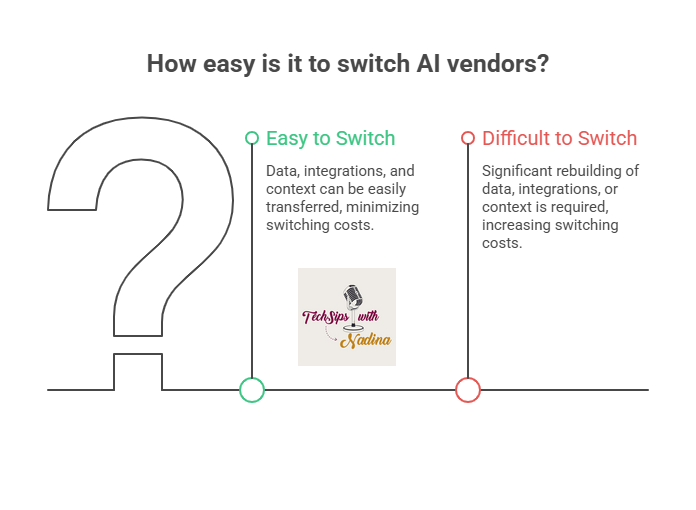
With regulators pushing assistants toward interoperability [2], portability is becoming a strategy question, not just a procurement one. Here is a quick way to see where you actually stand, and it is one worth doing yourself rather than routing to another team:
Pick the one AI vendor your group would least want to lose. Open its contract or its API docs in another tab.
Ask a single question. If we had to replace this in 90 days, what breaks first?
Write down the three things that hold you in place. Usually it is your data, your integrations (how it is wired into your apps), and the accumulated context or prompts you cannot easily export.
Next to each, mark whether you could take it with you today, or whether you would be rebuilding from scratch.
Email the note to yourself. That one paragraph is your real switching cost.
Most of your peers have never written theirs down. You do not have to leave a vendor to benefit from knowing that you could.
1 Big Idea
💡Building in Daylight
It took about two weeks for three groups with almost nothing in common to reach for the same instinct. The people closest to the technology asked for visible, verifiable ways to pace it [1]. European regulators told the largest mobile platform to let people choose and swap their AI assistant [2]. And 29 governments signed a cooperation body into being in Shanghai [3]. Different motives, one shared move. Trust in AI is shifting from a private assurance to something you can point at.
That is a friendlier development than it might first sound. The interesting part is not the specific rules, which will keep changing. It is that you can see how this works, and you can leave if you want to, is becoming a shared expectation rather than a favor. Systems whose limits are legible are easier to trust, easier to staff, and easier to build on. The line stops being a constraint and starts being information.
The European decision is really a story about choice. When people can move their assistant from one provider to another, no single vendor holds the whole relationship. That is the same logic careful architects have always liked. Keep your options open, keep the exits lit, and resilience follows from not being locked in. The pacing letter is a version of the same wish, made by the builders themselves: keep people able to see and steer, even as the systems grow more capable.
What all of this quietly frees up is attention. When the infrastructure is legible and portable, the people working alongside it spend less energy wondering whether they are trapped, and more on the work that actually needs their judgment. Openness is not softness. It is a way of making sure the humans stay the smartest part of the system.
You do not have to wait for any of these efforts to finish before borrowing the instinct behind them. Draw your own lines where you can see them. Choose tools you could walk away from. Build in daylight, and let the parts of your organization that need trust the most be the parts you can point to.
Tell me where your own lines are drawn, and whether you can still see them from where you sit. I read every response.
P.S. If a peer is rethinking how much choice they have built into their own AI stack, share this newsletter and help brew up stronger customer relationships.
P.P.S. If you found these AI insights valuable, a contribution to the Brew Pot helps keep the future of work brewing.
Resources
[1] OpenAI and Anthropic endorse call for government to 'pace' AI progress | The Washington Post
Sip smarter, every Tuesday. (Refills are always free!)
Cheers,
Nadina
Host of TechSips with Nadina | Chief Strategy Architect ☕️🍵