

“Checking your own work is a habit. Being checked is a profession.” — Nadina D. Lisbon
Hello Sip Savants! 👋🏾
California spent this month hiring for a job that doesn’t quite exist yet. On September 9 the governor signed SB 813, a framework for independent organizations to assess AI systems, and AB 1405, a state registry for AI auditors with standards for their independence, transparency and integrity [1]. The registry comes with a unique number on every auditor’s advertising materials, and a rule against seeking employment with a company while you are auditing it [2]. That is roughly the arc that turned bookkeeping into accounting, and this time it is happening in the open with a runway of years. The three items below are worth a few minutes of your week.
3 Tech Bites
📋 A profession gets its paperwork
SB 813 sets up a framework for independent verification organizations to assess AI systems for compliance with state law, and AB 1405, now Chapter 178 of the 2026 statutes, asks the Government Operations Agency to stand up an AI Auditor Registry by January 1, 2029 [1] [2]. From that date, a person who is not registered may not offer or conduct a covered AI audit [2]. There is also an AI Auditors Registration Fund paid for by annual fees, and an exemption for certified public accountants licensed by the California Board of Accountancy under specified conditions [2].
🎬 Labels for synthetic performers
SB 1050, signed September 16 at SAG-AFTRA headquarters, calls for explicit disclosure on any video or audio advertisement that uses AI-generated performers to sell a product or service, and bars continued use of an ad found in violation [3]. Sen. Angelique Ashby, who wrote it, asked that “synthetic figures be labeled as such” [3].
🧭 The build gets moved up
A September 18 executive order asks the Government Operations Agency to accelerate both laws, and with the Governor’s Office of Emergency Services to convene national experts for recommendations within two months [4]. Among the ideas to be developed: having safety frameworks, transparency reports and risk assessments verified by independent organizations, embedding those organizations onsite at frontier AI companies, and what the order calls an AI “kill switch” with ongoing efficacy verification [4]. None of that exists yet. It is a brief to go build it.
5-Minute Strategy
🧠 Who Wanted It to Pass
The new framework treats independence as something structural rather than personal, down to a rule that an auditor may not seek employment with a company while auditing it [1] [2]. That is a standard you can hold up against your own approvals, and it takes about five minutes.
Bring to mind the most recent AI capability your group approved for production.
Note who signed off on it.
Beside each one, ask what that person’s quarter would have looked like if the answer had been no.
Mark everyone for whom the honest answer is “worse.”
See whether a single name on that list is left unmarked.
An unmarked name is worth more than it looks, and worth protecting.
1 Big Idea
💡Registration Number 0001
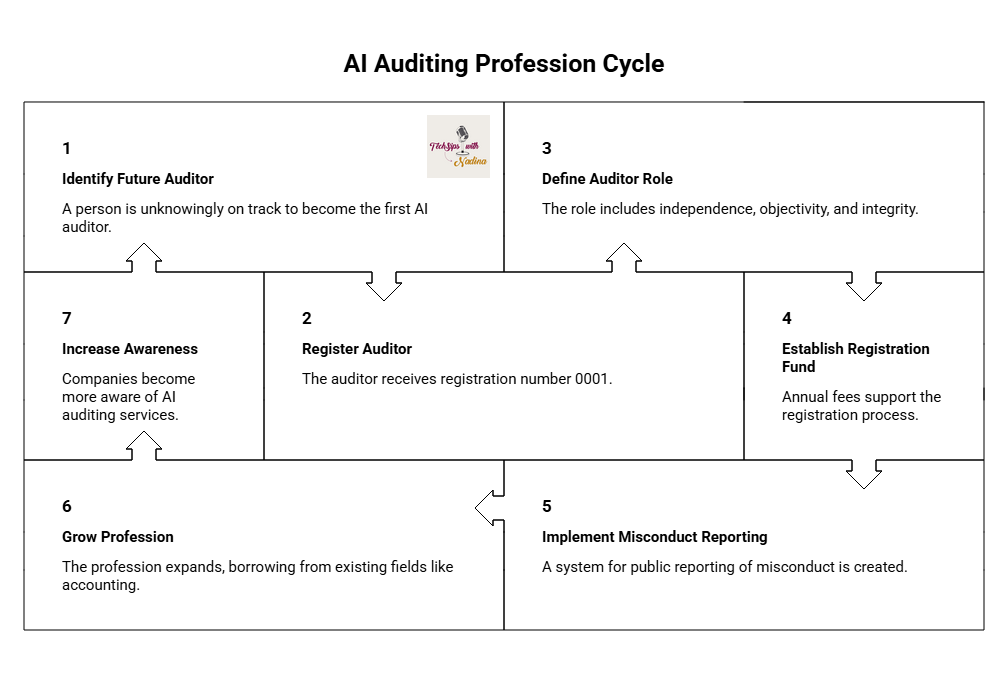
Somewhere right now there is a person who will hold AI auditor registration number 0001, and they almost certainly do not know it yet. Maybe she is a data scientist who keeps ending up in the meeting where someone finally asks whether the model does what the deck says it does. Maybe he runs internal audit and has been reading model cards on weekends because nobody told him not to. The registry is not due until January 1, 2029 [2], so whoever it turns out to be has a few years to get there.
What AB 1405 describes is less a rule than a job. A unique registration number that appears on advertising materials. Independence, objectivity and integrity. No seeking employment with an auditee while auditing them. A registration fund paid for by annual fees. A way for the public to report misconduct [2].
Read that list with the AI taken out of it and it sounds like a trade being founded. A number, an ethic, a fee, a door people can knock on. Financial auditing, building inspection and food safety inspection all started as somebody’s idea about who should be allowed to look, and under what conditions their looking would count. The particulars felt fussy when they were written down. They turned into careers people mention at dinner with some pride.
The accountant exemption is my favorite detail in the whole thing. It is a small drafting decision that quietly admits this is the same shape of work as accounting, a profession already built around independent looking and already carrying its own rules about it. New professions rarely arrive from nowhere. They tend to grow out of the nearest older one and borrow its manners for a while.
In the meantime, outside AI auditing stays voluntary, and plenty of companies already invite vendors in to look [5]. Miranda Bogen of the Center for Democracy and Technology said the new laws help give enterprises “more awareness of the options that they can turn to to obtain those services” [5]. Which means some of you have already met a future number 0002 or number 0017 and had no idea. Over the next couple of years, that seems like a pleasant thing to keep half an eye out for.
If you already have someone doing the outside look without the title, I would like to hear how you found them. I read every response.
P.S. If a peer is still bracing for cuts when the data points the other way, share this newsletter and help brew up stronger customer relationships.
P.P.S. If you found these AI insights valuable, a contribution to the Brew Pot helps keep the future of work brewing.
Resources
[2] AB 1405, Artificial intelligence: auditors: registration, bill record, CalMatters Digital Democracy
[5] What California's AI auditing bills mean for enterprises, CIO Dive, September 10, 2026
Sip smarter, every Tuesday. (Refills are always free!)
Cheers,
Nadina
Host of TechSips with Nadina | Chief Strategy Architect ☕️🍵